
Rotary Draw Bending
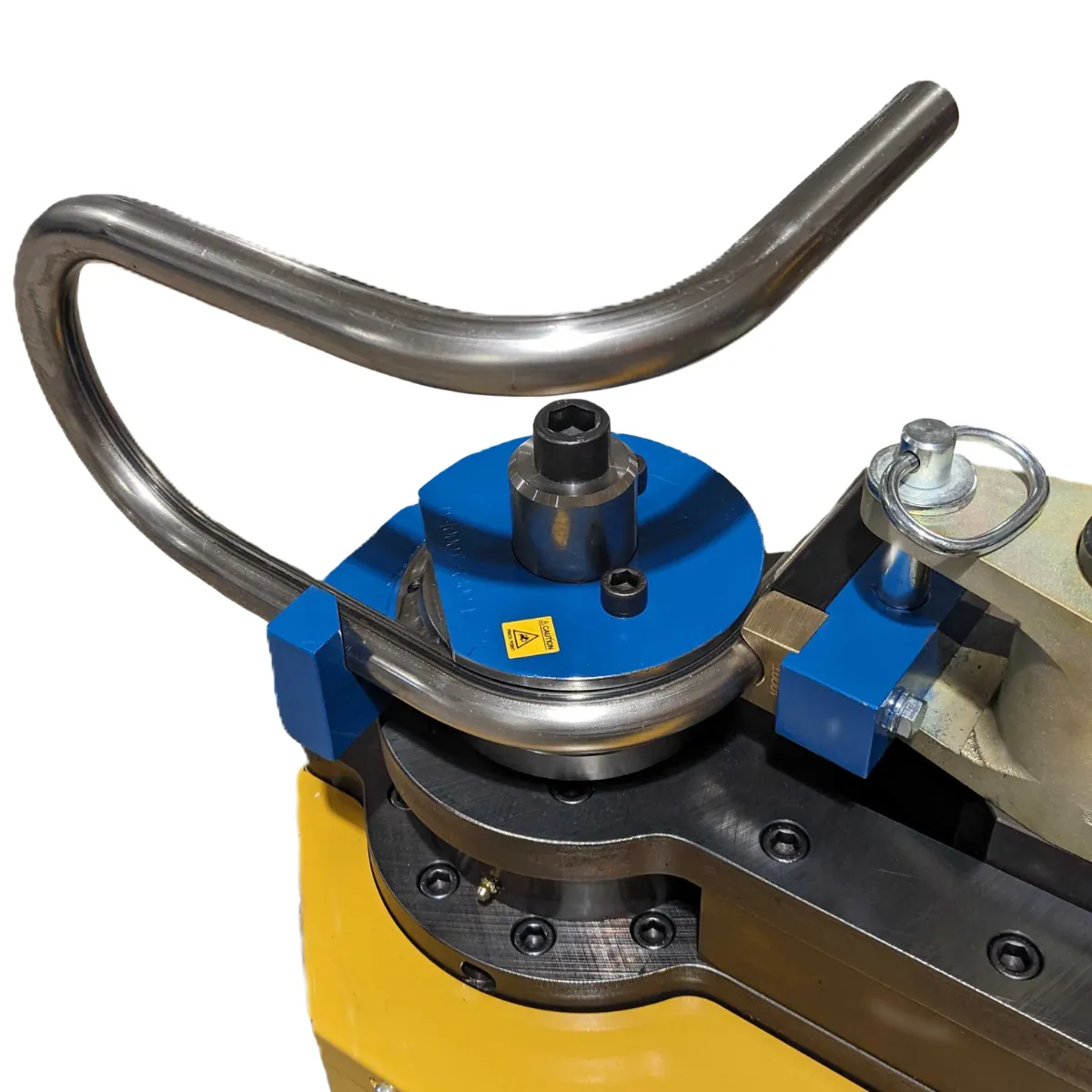
Rotary draw bending is one of the most widely used methods for bending tube and pipe.
The process clamps the workpiece against a rotating bend die and draws it around the die until it reaches the required angle, including compensation for springback.
The result is clean, repeatable bends with tight tolerances.
Common applications include:
- Hand rails and handles
- Framing
- Wire conduit
- Bumpers and roll cages
- Exhaust systems
- Fluid lines
Rotary Draw Bending Design Considerations
Tube vs. Pipe Bending
| Tube Bending | Pipe Bending | |
|---|---|---|
| Sizing | Defined by the outer diameter (OD) | Defined by the inside diameter (ID) |
| Wall Thickness | Measured inward from the OD | Measured outward and set by the pipe schedule (SCH) |
| Tooling | Same tube tool can bend many wall thicknesses | A pipe tool is specific to one size and schedule |
What Is Centerline Radius (CLR)?
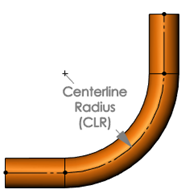
Centerline radius is the bend radius measured at the center of the tube. When a bend radius is specified for tube or pipe, it usually refers to the CLR.
What Is Wall Factor (WF)?
Wall factor is the ratio of tube outer diameter to wall thickness:
Wall Factor = Tube Outer Diameter ÷ Tube Wall Thickness
17 or less: Thick-walled tube that is unlikely to collapse.
17 to 19: Recommended maximum for bending without a mandrel.
20 or greater: Thin-walled tube with an increasing risk of collapse.
What Is D of Bend (DOB)?
D of bend is the ratio of centerline radius to tube outer diameter:
D of Bend = Centerline Radius ÷ Tube Outer Diameter
A DOB of 3 or greater is the ideal rule of thumb for bending without a mandrel.
What Is Distortion?
The tube may flatten slightly in the bend region.
Expressed as the percentage change in tube OD, measured at the midpoint of the bend.
A distortion of about 5% or below is typical.
See below: Excessive distortion (9%) shown for illustration.
Machine Capacities
Physical Constraints
Centerline Radius: Minimum - 0.5" (12.7 mm) | Maximum - 9" (228.6 mm)
Material Outer Diameter: Minimum - 0.25" (6.35 mm) | Maximum - 2.5" (63.5 mm)
Bend Angle: Up to 180°
Pipe
Mild Steel: Up to 2“ (50.8 mm) Schedule 40 (~60,000psi Tensile Strength)
Aluminum: Up to 2” (50.8 mm) Schedule 40
Stainless Steel: Up to 1.5“ (38.1 mm) Schedule 40
Round Tube
Mild Steel: Up to 2.5” (63.5 mm) OD x 0.125“ (3.175 mm) Wall
Aluminum: Up to 2.5” (63.5 mm) OD x 0.156“ (3.962 mm) Wall
Stainless Steel: Up to 2.375” (60.325 mm) OD x 0.125“ (3.175 mm) Wall
Chromoly: Up to 2” (50.8 mm) OD x 0.125“ (3.175 mm) Wall
Square Tube
Mild Steel: Up to 2” (50.8 mm) x 2“ (50.8 mm) x 0.125” Wall
Rotary Draw Bending Stock Tooling Constraints
Bend centerline radius will be larger than the tool centerline radius due to material springback.
Centerline radius growth of 3-5% is typical in steel tubing.
| Stock Type | Stock Dimension | Centerline Radius | Minimum Spacing |
|---|---|---|---|
| Round Tube | 0.500“ | 12.7 mm | 1.50” | 38.1 mm | 2“ | 50.8 mm |
| Round Tube | 0.750“ | 19.05 mm | 3.00” | 76.2 mm | 3.5“ | 88.9 mm |
| Round Tube | 1.000“ | 25.4 mm | 3.00” | 76.2 mm | 3.5“ | 88.9 mm |
| Round Tube | 1.500“ | 38.1 mm | 5.00” | 127 mm | 3.5“ | 88.9 mm |
| Round Tube | 1.750” | 44.45 mm | 6.00“ | 152.4 mm | 3.75” | 95.25 mm |
| Square Tube | 2.000“ | 50.8 mm | 7.00” | 177.8 mm | 6.5“ | 165.1 mm |
Rotary Draw Bending Tolerances
Bend angle: ±1°
Index angle: ±1°
Bend position: ±0.063" (1/16") | 1.6mm
Frequently Asked Questions
What is rotary draw bending used for?
It is used to bend tube and pipe for parts such as hand rails, framing, wire conduit, bumpers, and roll cages.
What is the difference between tube and pipe bending?
Tube is sized by outer diameter, so one tool can handle multiple wall thicknesses. Pipe is sized by inside diameter and pipe schedule, so each tool fits only one schedule.
What is the ideal D of bend for non-mandrel bending?
A D of bend of 3 or greater is the recommended rule of thumb.
What bend angle tolerance can you hold?
Our standard bend angle tolerance is ±1°.
Get Started
NEED DESIGN HELP?
Our experts can design your custom enclosures exactly as you want them.