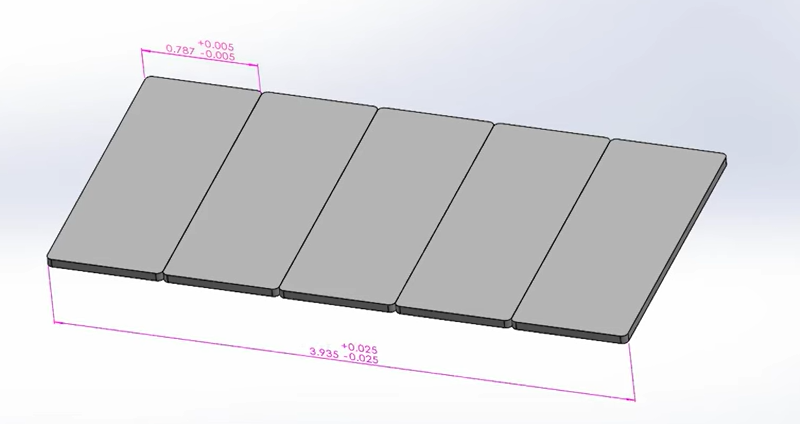
Tolerances represent the allowable variation in dimensions for a part or assembly. They ensure that individual features fit together correctly during assembly and function as intended. However, when multiple tolerances apply to an assembly, these variations can “stack” together, potentially leading to dimension-related issues.
To illustrate this, imagine a sheet metal assembly consisting of five panels aligned side by side, each designed to be 0.787” (20mm) wide with a tolerance of +/- 0.010” (±0.254mm). Due to the tolerance for each panel, the total width may actually range from 3.877” (98.5mm) to 3.996” (101.5mm). This is the result of tolerance stacking.
Due to this reason, stacked tolerances can significantly impact the manufacturability and performance of sheet metal parts.
When tolerances stack beyond acceptable limits, a bunch of problems may arise such as: parts not fitting together due to improper alignment, cutouts and bends can become slightly misaligned during assembly, both causing delays in manufacturing with unnecessary iterations and therefore an increase of cost.
Factors That Contribute to Stacked Tolerances
Before getting into design advice, it’s important to understand which key factors contribute to stacked tolerances in sheet metal.
Complex Designs
During the design phase, multiple dimensions and tolerances are specified and when these dimensions interact, their tolerances can compound.
Intricate designs with closely-spaced features or geometric relationships can be more susceptible to tolerance stacking. Misalignments or deviations in one feature can cascade across the design, leading to an increased accumulation of errors once assembled.
Material Properties & Behavior
Sheet metal materials can exhibit variations in thickness, elasticity and thermal expansion, all of which can influence dimensional accuracy. These variations become more prominent when multiple assemblies are fitted together, further contributing to tolerance stacking.
Design Tips
Now that you understand the importance of a stacked tolerance, let’s look at some tips that will help you design smarter:
Simplify Your Design
Where possible, reduce the number of individual parts in your assembly. By consolidating parts, you can minimize the accumulation of tolerances.
Establish Functional Tolerance Zones
Focus on your critical dimensions first that directly influence the functionality of your part and loosen the tolerances for any other less critical areas. This approach will require a deep understanding of your parts functionality, as you will be playing with both functionality and manufacturability.
To put this design advice into perspective, consider a sheet metal enclosure with multiple tabs for mounting electronic components inside. If each tab’s position tolerance is +/- 0.010” (0.254mm) the accumulative deviation may lead to misaligned components.
To address this, you could:
Group tolerances into functional zones and tighten tolerances for the interior where components align and loosen the tolerances for the exterior of the enclosure.
Conclusion
To conclude, stacked tolerances may be a small detail, but they can cause big problems if overlooked for complicated designs. For engineers designing with sheet metal, understanding and addressing tolerance stacking is essential for creating manufacturable and reliable products.