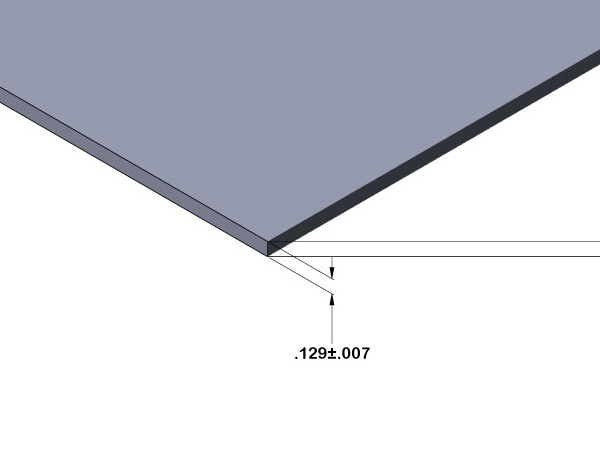
Accuracy is our top priority, but a little bit of dimensional variation is naturally part of our process. Our tolerances are the maximum limits for dimensional variation that we can tolerate before a part is considered “out of specification”.
In the real world, exact precision is rarely achievable due to limitations in materials, processes and machinery. Tolerances provide a “safe zone” that ensures parts function correctly while accounting for these variations.
For example, a piece of sheet metal may have a specified thickness of 2 mm with a tolerance of ±0.1 mm. This means the thickness can range between 1.9 mm and 2.1 mm without compromising functionality.
Proper tolerances ensure that parts fit together seamlessly, which is especially important for assemblies. Tight tolerances are crucial for parts that require precision alignment or interact with other components.
It’s also important to set realistic tolerances to cut down on errors and minimize waste. If your tolerances are too strict, you could end up with more rejected parts, wasted materials and extra time spent fixing things.
Material properties like thickness variation, elasticity and hardness impact how metals behave during processing. Thinner sheets are more prone to warping, while materials like aluminum and stainless steel require specific considerations to ensure tolerance accuracy.

Aside from material tolerances, you need to also consider tolerances for profile cutting, CNC machining, bending, self-clinching fasteners, finishes, part markings, graphics, 3D printing and countersinking.
For instance, if bending is involved, keep in mind that parts with complex features or tight bends can be trickier to produce with exact precision. Plus, adding holes or cuts too close to the edges or bends can cause deformation or misalignment.
It’s also important when working with sheet metal that you factor in finish tolerances. For example, if you’re going with a powder coat finish, be sure to allow for a tolerance of +0.003” (or 0.08mm) when working with us.
Now, at Protocase, we use bilateral tolerancing unless stated otherwise. You might know it as symmetric tolerancing, it means we use equal plus and minus deviations from the nominal dimension.
It is crucial that you allow for these tolerances in your design. Dimensional variance is something all mechanical designs must contend with. As a designer, keeping our tolerances in mind while working on your designs will lead to better results. On the other hand, simply assuming all parts are the exact nominal size may not work as effectively.
Our website has all the info you need on dimensional tolerances for sheet metal and machined parts. Whether it’s material specs or manufacturing tolerances, we’ve got you covered.
At Protocase, we leverage High-Velocity Mass Customization (HVMC) to serve as your one-stop shop for fully finished sheet metal and machined parts. Whether it’s adding precise cutouts or applying custom graphics, we handle it all. Best of all, we can manufacture fully finished custom parts in as fast as 2-3 days.
If you have a design ready, get an instant quote now!
Newsletter Signup
Sign up to be the first to know about new blog posts and other technical resources
Stay Updated
Subscribe to our newsletter
to get our latest news.
Proudly Certified
© Protocase 2022 - All rights reserved.