
Frequently Asked Questions
I was told my enclosure should be made of 16 ga steel. What does this mean?
ga., or Gauge, refers to the thickness of the material being used. There are a number of gauges, each of which is specific to the type of material in question, so an actual thickness specification (in inch or millimeter units) leaves less room for error. See the Materials, Components, and Finishes page for more information, including standard stocked gauges.
Which types of material does Protocase use in manufacturing enclosures?
Protocase manufactures enclosures from virtually any metal. Standard stock materials include steel, stainless steel, galvanneal, and aluminum. See the Materials, Components, and Finishes page for more information.
What does a 1U enclosure mean?
1U is a standard rack enclosure height. It refers to the height of the front panel and also dictates the location of the front panel mounting holes. The following table shows the front panel height for the various standards.
| Standard | Nominal Front Panel height |
| 1U | 1.75 in |
| 2U | 3.50 in |
| 3U | 5.25 in |
| 4U | 7.00 in |
| 5U | 8.75 in |
| 6U | 10.50 in |
| 7U | 12.25 in |
What is the biggest enclosure you can make?
It depends on the geometry of the enclosure. The main limitations are 4' x 8' (1220mm x 2440mm) limitation imposed by our standard sheet metal stock, and a 6' (1830 mm) bend length limitation imposed by press brake equipment.
Are there limitations on the shape of the enclosure?
We can manufacture all the common enclosure styles, and when it comes to fully custom designs, we have an enormous amount of flexibility. We use toolless cutting techniques, so any shape may be cut. The main limitation is in bending. Press brakes can do straight-line bends only. There are few limitations on the first bend on a part, but elements of the part may interfere with subsequent bends. Contact our technical staff for more information.
How can I send you my enclosure design?
An electronic CAD file is the best way. Ideally a 3D model such as Solidworks or an IGES file works best. Otherwise, AutoCad dxf or dwg drawings will suffice. If you don't have CAD capability, fax (1-902-567-3336) or email (info@protocase.com) us your hand sketch and we can take it from there.
What is a self-clinching fastener?
To facilitate mounting your printed circuit boards, power supplies, or other devices, Protocase offers a variety of self-clinching threaded standoffs, threaded studs, or nuts. These come fully pressed into your enclosure or part, and are available in both metric and english sizes. Standard sizes include #4-40, #6-32, #8-32, #10-24, M3, M4, and M5. Please identify your desired fasteners in the enclosure drawing that you will provide to us when you place your order. More information on self-clinching fasteners can be found here.
Are there restrictions on the shape and size of cutouts?
There are virtually no restrictions. We can cut almost any shape or size cutout provided it fits within our enclosure size limitations.
What are the dimensional tolerances of your enclosures?
The dominant dimensional variation occurs in cuts and bends. Cuts have an absolute accuracy of better than 0.010” (0.25mm), relative to CAD drawings. For bends, variation occurs in leg length as well as angle. Standard leg length tolerance is 0.010” (0.25mm), and bend tolerance is 2 degrees. See our Fabrication Tolerances page for more information.
Is there a maximum number of cutouts you can do per side?
There is no limit to the number of cutouts. As a rule of thumb, cutouts should be no closer than 1.5 x metal thickness from another cut, although there is some leeway in practice. Also, parts with a very large number of cutouts may warp from heat and/or relief of residual stresses inside the metal. Consult with our tech staff should you encounter either situations when designing.
I need some brackets to hold down power supplies and fans. Can you supply these?
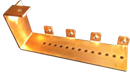
Yes, we commonly build internal components such as brackets, ground planes, internal partitions, etc., as an ordinary part of enclosure manufacturing.
Can you install my hardware?
Yes we can install your specified self-clinching fasteners, studs, and nuts, rubber feet, handles, etc, where required (although sometimes they are better left off for shipping purposes). See our materials, components, and finishes page for more information.
I only need one enclosure for a prototype design — does this fall in your definition of 'low volume'?
Yes. We are here to help engineers and designers get their projects done quickly. They often require only one enclosure or small metal part. Therefore we have absolutely no minimum order.
My enclosure requires sealed seams. Can you seam weld my enclosure? Do you grind after seam welding?
Our welding capabilities include spot welding (a great option for permanent assembly) and Cold Metal Transfer (CMT) for fully sealed seams, which are ground smooth prior to finishing.
Can you silk-screen my front and rear panels?
Yes. All we need is your graphic and we can take it from there. Silk-screening adds 1 day to lead time to allow ink to dry. Extra days may be required when multiple colors are overlaid, to allow for drying time between applications. See our silkscreening page for more information.
What standard silk-screen colors do you offer?
We stock a variety of colors. We can also supply custom colors, but their use may add to delivery time. See our silkscreening page for more information.
I need my enclosure right away. It's not a standard shape and has some unusual cutouts. How fast can you deliver?
Most enclosures are typically shipped within 2-3 business days after the client has approved the design, regardless of level of customization or complexity. However, extra lead time may be required for silkscreening (due to drying time), use of non-stocked components or materials, or large quantity orders. If time is critical for your job, be sure to discuss it with our sales and/or technical staff, and we can review your design to determine the leadtime, and suggest workarounds for any design elements that may result in delays.
What standard powder coat colors do you offer?
We stock a variety of colors, in a variety of textures. We also can supply non-standard colors but sometimes these will add to the delivery time and/or cost. See our powdercoat page for more information on powder coat, including a list of stock colors.
I have limited CAD capability. Can you help me with my design?
We work with many customers who are experts in their own field of science or technology, and design and build electronics but have never developed CAD expertise. We have a number of simple options for them. For example, they can utilize our design services. They simply contact us and describe their needs, and once we establish a rough idea of your requirement, we can give a firm price on the enclosure and design fee. This is a fast and cost effective option, and very often design services don't exceed $100 US. Another option is to use our Protocase Designer® free 3D enclosure CAD software, which can be learned in 20 minutes with the help of detailed video tutorials, and provides instant pricing and online ordering. Finally, a non-CAD expert can use our online template generator to create a base enclosure design, and specify output line-drawing format. He/she can view the drawing in a web browser, then print out each face, and draw in cutouts and/or fasteners as required to develop a custom enclosure design.
If you do the design for me, can I review the design before it is made?
We supply every customer with an eDrawings of his or her enclosure or part prior to it entering production. This is a 3-D model of the enclosure and provides the client the ability to verify dimensions, view the enclosure from all angles, view section cutaways to inspect the inside and dissemble the enclosure to view each part that makes up the assembly. This model is a simple html file and requires no special software to run, just an Internet Explorer 5.5+. And best of all, it's free.
How long will I have to wait for my enclosure?
There are two stages to the ordering process. Once the order is received, an eDrawings is produced and sent to the client for approval. eDrawings are typically sent out within 24 hours of receiving the order. Once an authorization to proceed is received from the client, we typically will ship within 2-3 business days. For enclosures with silk-screening, add 1-2 days.
Can you manufacture aluminium enclosures?
Yes. We stock aluminum as well as steel, stainless, and galvanneal, and can usually obtain any other metal that a customer may require.
How do you ship my order?
We ship the products by express courier, unless otherwise notified to us.
What is your return policy?
If there is a problem with the product, please contact us right away. We will replace, at no cost, any product not manufactured in accordance with client approved eDrawings or any product not deemed to be of acceptable quality to both Protocase and the client.
What size stand-offs do you stock?
To facilitate mounting your printed circuit boards, power supplies, or other devices, Protocase offers a variety of self-clinching threaded standoffs, threaded studs, or nuts. These come fully pressed into your enclosure or part, and are available in both metric and english sizes. See our self clinching fastener page for information and a list of stocked items. Please identify your desired fasteners in the enclosure drawing that you will provide to us when you place your order.
How can I pay?
We accept all major credit cards (VISA, AMEX and Mastercard), wire transfers, and cheques drawn on major banks.
What currency do you work in?
Our default currency is in USD. However, if you would find it more convenient, we can quote, invoice, and accept payment in GBP, EUR, and CAD. Pricing in alternate currencies will be based on the USD price, using our effective conversion rate, and we will hold alternate currency pricing for 30 days.
Dot Peening FAQs
What is Dot Peening?
Dot Peening is a form of permanent marking on sheet metal parts.
Why should I use Dot Peen Permanent Marking?
Dot Peen Permanent Marking is used for the traceability and identification of sheet metal parts. This form of identification is typically used to meet safety, warranty, or regulatory requirements.
How does Dot Peening work?
An alphanumeric pattern is first programmed into the dot peening equipment. The machine head is laid over the part while it is still flat (before bending and finishing) and a series of dots are then created by the impact of the pin. The end result is a readable, alphanumerical identification.
Which materials should I use with dot peening?
We can dot peen any of our materials, but there are considerations when using thin gauges. Specifically, when dot peening aluminum thinner than 0.051” or steel less than .048”, ghosting or witness marks may show through on the reverse side. This is only an aesthetic issue and in some cases may be perfectly acceptable. Therefore, in cases where dot peening is to be specified on these thin materials, the designer should carefully consider where witness marks may show up.
Can I order permanent marking for my sheet metal part with a powder coat finish?
Dot Peening can be used on bare metal finishes or under powder coat, as the depth of the peening is sufficient to show through the paint.
*Please note* The presentation of the dot peened characters will vary from the different powder coat colors. See some examples of dot peening under powder coat HERE.